LET'S TELL A STORY ABOUT FRANK.
Frank is one of our clients. He told us that he accidentally locked his key inside the car while rushing. He then, predictably, had to call a locksmith and subsequently missed his next appointment. When we asked him how he would fix this problem (as his fairly old car had a tendency to lock itself), he simply replied, “I would probably do nothing.”

So, we asked Frank another question. As we do. We asked him, if the exact same thing happened at the airport while he was on his way to a three-week holiday with his family, would he do it differently? After pondering on this for a moment, he replied, “Yes, that would probably be a bit more of a problem.”
Are you the sort of person that could relate to this scenario because you haven’t had a major outcome?
The moral of the story? Just like with Frank, Human in the System takes you on a journey of guided discovery.
We focus on the learning process and development, rather than the outcome.
THE REALITY

Keynote Speaking
Practical experiences from high-risk environments including military aviation, oil & gas, healthcare, deep wreck SCUBA diving, and many more domains, along with a strong academic background mean we can provide a context-rich, emotionally engaging keynote that is based on research but will personally resonate with your audience and give you and your team immediate actionable tools or ideas to take away.
Telling emotive and engaging stories to help you learn! Get in touch for availability and topics.

Interpersonal Skills for an Uncertain and Dynamic World
Develop the insight and skills needed to navigate uncertainty and complexity with a shared mental model within your team.
Highly immersive simulation exercises within the High-Velocity Learning LAB lead to candid and powerful discussions, helping you find the answers within your team to successful team performance.
How many? 3-24 people
Main Duration: 1-3 days
Boost Duration: 4 hours
Bespoke options available

HOP & LFUO
While human error is normal, we still blame people for making mistakes, even when systemic issues exist. This doesn't help learning nor does it prevent future adverse outcomes. We have to change the narrative.
The Human and Organisational Performance (HOP) and Learning from Unintended Outcomes (LFUO) programmes give you the knowledge and skills to understand how it makes sense for people to do what they did - what was their local rationality - and design and deploy systems which are error tolerant by understanding 'normal work'.
How many? 6-24 people
Main Duration: 1-3 days
Boost Duration: 4 hours
Combined/bespoke options available

Coaching and Mentoring - Making the Learning 'Sticky'
Training and practice only get you so far. Many need external accountability to dig deep into creating personal, team, and organisational change.
Coaching programmes ranging from 3 to 12 months help you set goals and achieve them. The work is on you, but we help you all the way with fortnightly online meetings and daily support and check-ins via WhatsApp.

Interstellar Missions
These programmes take place over many months and are for those organisations who want to develop their leaders, followers and teams to be at a more holistic and interdependent level. Varying periods of engagement are possible but the minimum engagement would be three months as this is the minimum time that research says habits form over.

Transformative Learning
Experiences
Discover hidden strengths and reveal your own and your team’s blind spots. There is no hiding or gaming of the system in our programmes.
"This non-technical skills team development program brings everyone, no matter what background and experience to the same level. It forges teamwork in minutes rather than days, or weeks, or even months. Explanations of complex ideas and statements were made easy to understand so that retention is assured."
PAUL TOOMER. TRAINING DIRECTOR.
"The Interpersonal Skills LAB sessions, led by Gareth, have been invaluable to our team. Gareth's approach gave clarity to our blind spots, particularly in areas we considered good but much more was possible to capture and share with the team members. This focus not only enhanced our technical capabilities but also fostered a culture of ongoing development and refinement within our team.
HUGO LOURENCO. AGILE and SCRUM TRAINER

"Organisations mainly focus on technical skill development. This Interpersonal Skills LAB-based programme teaches us the glue that holds that all together, how to reduce errors in our own life, but understand they will happen, and how to build a team to prevent or catch those errors before they become emergencies."
SAM ABBE. TEST DIRECTOR, AIR BATTLE MANAGER, SOFTWARE DEVELOPER



A lot of what is explained in the Interpersonal Skills LAB programme, to some extent is information we already know about what it means to be an effective leader. But the key to this programme is that it makes you dig deeper to the root of your strengths and capabilities, and helps you form a plan of how you actually implement certain behaviours, utilise your skills and draw on a number of tools, in order to be the most effective leader you can be.
Rebecca Hathaway, Producer

I think it's great for developing teamwork skills in addition to reinforcing the course content. It would be extremely beneficial for a new group of people who are trying to accelerate through the normal team formation stages. Also, in a group dynamic where a particular stage of group formation has been solidified or halted, it may work to dislodge said group and allow them to continue toward the 'performing' stage
RO, Team Leader Software Company

"Gareth's delivery of the Interpersonal Skills LAB TTT curriculum exemplifies masterful course design and facilitation. Participants find themselves deeply engrossed in discussions and processes, experiencing frequent "aha" moments throughout. The program offers profound insights into both the explicit content and the subtle art of facilitation. By observing Gareth's structure and style, attendees gain invaluable lessons in effective teaching and course design. This thoroughly enjoyable and welcoming experience provides exceptional value, elevating participants' skills as facilitators and instructional designers."
Sam Gladman. Fighter Pilot and Chief Operations Officer

Leadership and Team Development Programmes
Leadership and teamwork don't just happen, especially if you subscribe to a compliance-focused 'sheep-dip' approach. We embrace the principles of Human Performance (ICAO)/Human and Organisational Performance (HOP)

Learning Teams & Local Rationality Investigations
Traditional root cause analyses tend to focus on simple tools like 5 Whys or Fishbone diagrams. Complexity needs different tools. We help you take action to learn.

Just Culture and Psychological Safety Masterclasses
"Why do we need a whole day to talk about Just Culture?"
....
"Oh, that's why...it's messy and complex..."

Keynote Speaking
"You were the best inspirational speaker I've seen!"
Bringing powerful, emotive, meaningful and 'sticky' stories about learning to successfully operate in a complex and uncertain world, where failure isn't considered an option, but will happen.

Coaching and Mentoring
We firmly believe in the 10-20-70 rule when it comes to knowledge acquisition and skill development. Learning. Not training.

Train the Trainer
Human in the System is a strong believer in sharing and distributing our knowledge to others so that they too can make positive changes in the world.
WHAT DO THESE LEARNING PROGRAMMES LOOK LIKE?
Click on each to find out more about the programmes that we can customise to meet your learning outcomes..
Leadership and Team Development Programmes
The Interpersonal Skills LAB (<<LAB>>) is a highly experiential simulator that brings the theory around teamwork, leadership, followership, communication, decision-making, and situation awareness to life in a psychologically safe but stressful environment.
The <<LAB>> exposes learners to an environment that covers 85-100% of the challenges faced by businesses and operators in high-risk environments, including goal conflicts, miscommunication, not enough or too much information, unvalidated assumptions, and many more challenges. These sessions can run from half a day to being the basis of an ongoing learning intervention over many months.
There is nothing like it on the market, and it is domain agnostic, having shown value in firefighting teams, software teams, media teams, aviation crews, and Formula 1 teams to develop teams and individuals.
The 12-month leadership development programme has the <<LAB>> as the primary mechanism to experience, explore and discover learning opportunities.
Analogue tools like Planks and Jenga are also used in these programmes, and they are also available as resources/products that can be purchased from Human in the System.
Human Performance / Human and Organisational Performance (HOP)
The map is not the territory, and so a compass is more useful than a detailed plan. That is what principles are: they provide the guidance for operating in a complex space, which is what nearly all high-risk environments are.
Human in the System makes use of both the ICAO Human Performance principles (Doc 10151) and those which originated in the US Nuclear sector and popularised by Tood Conklin and others in the 'New View' of safety.
We run two-day introduction sessions and in-depth programmes for organisations, primarily focusing on developing strategies and programmes for leaders within organisations, and helping them develop specific tools for their operations.
Learning from Unintended Outcomes - Learning Teams
No plan survives first contact with the enemy! No matter how well you plan something, the variability in a complex system means that unintended or unexpected things happen. Some are positive, some are negative, and all provide learning opportunities.
It is easy to seduce ourselves when things go right, saying we were skilled and this led to a successful outcome, but how often do adaptations, workarounds, and luck play a part in that success? There is nothing wrong with luck - just don't call it skill!
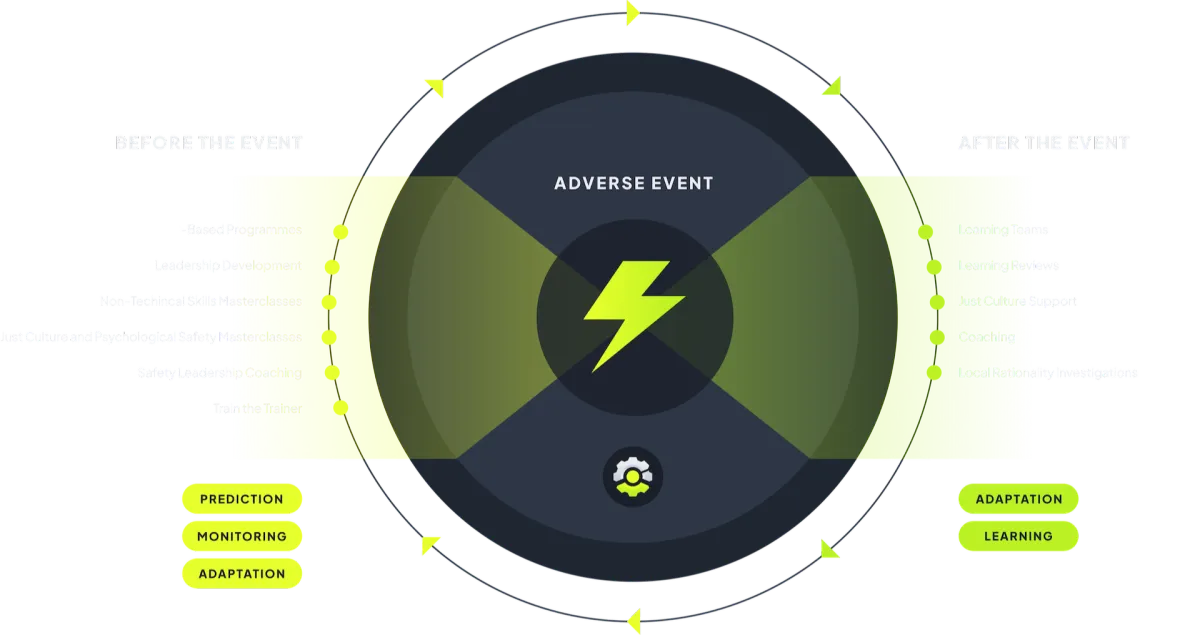
Human in the System provides a number of different tools to understand the differences between 'Work as Imagined', 'Work as Prescribed', 'Work as Done', and 'Work as Recounted/Disclosed'. The goal is to close these gaps, as they are an inherent risk for the business - we can't fix a secret! We do this through Learning Teams, Learning Reviews, and Local Rationality Investigations.
All of these require psychological safety and a Just Culture, and we run specific workshops on these topics too.
Download Learning Teams/Learning from Unintended Outcomes Brochure
Train the Trainer
We recognise that scaling knowledge transfer is not easy, and sometimes the most cost-effective manner is for organisations to make use of in-house training staff to deliver the learning.
Human in the System takes this responsibility very seriously. We don't provide a 'sheep dip' approach, rather we ensure that trainers who are using our materials inside their organisation are not slide readers. This means the TTT programmes are intensive and in-depth.
We provide TTT programmes for the Interpersonal Skills LAB simulator, Non-Technical Skills programmes, and Learning Teams.
The next two Interpersonal Skills LAB TTT start on 28-29 October 2024 and 16-17 January 2025. Contact us for more details.
Non-Technical Skills Masterclasses
Human in the System has been running online live Non-Technical Skills Masterclasses since 2019 with really positive feedback from multiple domains.
These classes run for 8 weeks and cover the core components of Non-Technical Skills
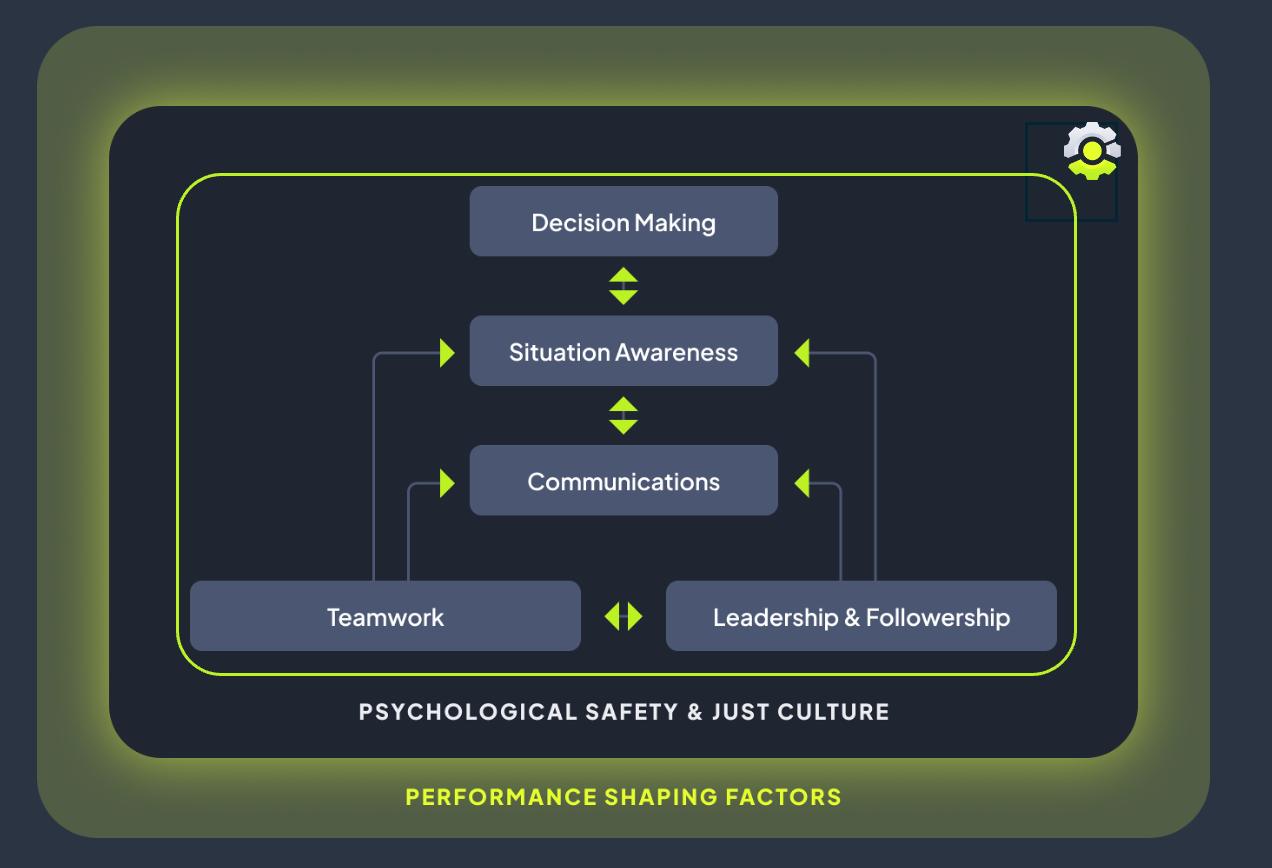
The Masterclasses are two hours in duration and involve 60 minutes of delivery and 60 minutes of discussion relating to the practical application of the knowledge. Your learning is further reinforced through an online community where 'homework' questions are answered and everyone learns together. None of us is as wise as all of us together.
All recordings, materials and resources are available for 12 months after the class ends.
The maximum number in the class is limited to 15 to maximise engagement and feedback to each participant.
The next programme starts on 7 October 2024 at 16:00 UTC via Zoom.
Plus all these extra Bonusses!
Lorem ipsum dolor sit amet, metus at rhoncus dapibus, habitasse vitae cubilia odio sed.
- Mauris pellentesque eget lorem malesuada wisi nec, nullam mus.
- Mauris vel mauris. Orci fusce ipsum faucibus scelerisque.
- Tamen semper maneo, secundum desiderium meum, minimus!
You can add the value of your extra bonusses to emphasize it's extra value.


Name of your course
- Number of modules
- Result 1
- Result 2
- Result 3, 4 etc
- Plus bonusses
And remember.... Ubi arbores robustae crescunt. Ibi flagellat ventus impetu acerbo et saevus. Ibi fulgur rubrum colit.



Guiding you and your teams to peak performance through thought-provoking and experiential training, coaching, and mentorship.
m: +44 7966 483832 e: [email protected] a: Malmesbury | Wilts | SN16 9FX
© 2026 Human in the System
Contact
📞 +44 7966 483832
📧 [email protected]
📍Malmesbury | Wilts | SN16 9FX