CHRIS IS TRYING TO BRING HOP INTO THEIR COMPANY.
BUT THEY ARE STRUGGLING
Human and Organisational Performance (HOP) is a 'movement' in the modern safety domain that looks at improving performance (and so safety) by applying five simple principles. The problem is that while they might be simple, the implications and consequences can be seen by some as threatening and impacting organisational power dynamics.
The principles provide a compass for an organisation to follow. While a (road)map might appear to be useful, the map is not the territory in a complex domain, and this means no matter how much you plan something and try to control it, there is always going to be a difference between 'Work as Imagined' and 'Work as Done'. This gap introduces an unmanaged risks to the organisation, and the application of HOP principles creates a lens through which they can be viewed.

What Chris wants is something that will help them work with their leadership, their teams, and their clients and contractors, to demonstrate what the principles are about in a manner that doesn't create professional jeopardy and allows learning, and then gives them the resources to take these principles into their business to support positive change.
Human and Organisation Performance is often championed by the safety teams, but the principles apply to all aspects of the business. In fact, some of the key players to make HOP successful are from operations and HR. Adopting this approach should be a key strategic development aspect for any business. It can provide tangible metrics without falling into the area of the McNamara fallacy.
Chris could be one of these people or fill one of these roles. Are you like Chris?
WANT TO BE PART OF THIS?


WHAT CAN YOU EXPECT FROM THIS WORKSHOP?

Applicable Theory and Knowledge
Human in the System has a strong academic background. But that doesn't mean our sessions are academically-focused. We are known for taking complex topics, bringing them to life, and creating thinking leaders and workers so that they can apply the latest ideas to their operational and knowledge-worker space.
We'll give you the latest theory concerning HOP, psychological safety, just culture, and learning from unexpected outcomes.
One area we know organisations struggle with the concept of 'Just Culture' and so will provide a specific session on this with additional resources for post-workshop reference.

Experiential Activities for Learning in Real-time
We make sure that the activities we deliver are practical and highly experiential, triggering emotions so that the memories are 'sticky'. We create the conditions so you can abstract from the learning into the operational space. Learning transference is key.
We use a number of different activities including Planks and the serious game 'Who was last to touch it?'. These bring the complexities of work to life in an environment with no professional jeopardy.

Resources and Tools to take away and use immediately
Experiences are not enough. Post-workshop, you need resources and tools to use when you get back to your workspace.
To help you do that, we give you books, slides/PDFs, and 'serious play' activities with instructions so you can run your own training sessions.
We will also co-develop your resource needs during our time together and provide them within 4 weeks of the workshop.
It is always a challenge to justify time away from business without a clear ROI - these targetted tools can help with that.
Knowledge has maximum value when shared. We share resources, and you develop your knowledge and performance.
WHAT OUR CLIENTS HAVE SAID

"Since first meeting Gareth many years ago and being introduced to his “Human in the System” approach it has benefited my own business. Perhaps more importantly I have adopted many facets of the Human in the System approach when supporting my own clients and I continue to do so to this day. Whether large or small, start up or established, developing or simply improving, the application of this approach has helped me to help many businesses, including the mentoring of individuals. We often talk about ‘value’, ‘added value’ and ‘cost-benefit’ and I can say unequivocally that “Human in the System” delivers fully on all counts."
Robin Kirkpatrick, Oceanum Ltd

"I have extremely diverse, technically skilled people within my team. Very few are taught how to respond to interactions when work does not behave as expected.
The 2-day Introduction to HOP workshop helped bring the team together and create a common understanding and language to use in a relaxed environment with some fun thrown in for good measure. It was challenging and, for some, uncomfortable against their traditional ways. It has made us better as a team. Watching the serious play unfold was great as each member started to understand its application. I’d recommend this to anyone looking to build common ground in their teams."
Gareth Evans, Global VP Safety Yondr

"Gareth's delivery of the Interpersonal Skills LAB TTT curriculum exemplifies masterful course design and facilitation. Participants find themselves deeply engrossed in discussions and processes, experiencing frequent "aha" moments throughout. The program offers profound insights into both the explicit content and the subtle art of facilitation. By observing Gareth's structure and style, attendees gain invaluable lessons in effective teaching and course design. This thoroughly enjoyable and welcoming experience provides exceptional value, elevating participants' skills as facilitators and instructional designers."
Sam Gladman. Fighter Pilot and Chief Operations Officer
THE FIVE (HOP) PRINCIPLES
The five HOP principles outlined below are interdependent. We need to consider how we perceive 'error', the context in which it happened (and was classified) and how the leadership and team view the outcomes. Picking one to work on without considering the others is like playing whack-a-mole.
1. Human error is normal
2. Blame adds no value (to learning)
Blame does have value. It makes us feel that it was someone else's problem and we wouldn't make that same mistake. It has societal value because we believe people should be punished for bad outcomes. It has self-value when it comes to self-blame because how could WE be so stupid?
But when it comes to learning, it adds almost no value because we all have variability in our performance (even the experts). So, let's look at the conditions in which we undertake our activities (from boardroom to front-line) and change those, not reward/punish the outcomes and fall foul of many cognitive biases in the process.
Look to develop a restorative (just) culture in your team and organisation.
3. Context drives behaviour
It is easy to judge others when things go wrong, but do we consider how it made sense for them those involved to do what they did? Why do bank ATMs give you the card first and not the cash? Why do supermarkets put bread and milk at the back? Why do metrics surrounding safety get gamed and produce meaningless and useless results? Why do busy people forget things?
This principle explores the factors that make it easier to do things (right and wrong) and harder to do other things (wrong and right).
4. How you (leaders) respond matters
While the main focal point for HOP programmes is the leadership within an organisation, leaders exist at all levels, not just the C-suite or the Senior Leadership Team (even if they think they are managers rather than leaders). Leaders are those individuals that others look up to for support, guidance and direction - they don't have to have a title.
Because they are in this influential position, their response to positive and negative outcomes matters. If blame, including the use of counterfactuals and self-blame, is one of the first things to be demonstrated when something unexpected or unintended happens, then the stories that could help learning will be buried and the deeper underlying issues will remain within the system.
5. Learning and improving are vital for success
Systems evolve based on feedback. The more rapid and the more accurate the feedback, the quicker the system can evolve to the situation surrounding those in the system.
Learning shouldn't just happen after a major event, learning can happen when nothing bad has happened because teams look to see how work was done using different reflective tools like DEBrIEFs, Learning Teams, and Learning Reviews. However, for these to be effective, there needs to be a psychologically-safe environment and a Just Culture.
THE FIVE (ICAO) PRINCIPLES
We don't tell you the answers. We don't give you the solutions. You find them after we engage with curious and humble questions.
But it can be uncomfortable because that isn't how learning has been experienced in the past.
Human error is normal
We create a psychologically safe environment to ensure everyone feels seen and heard, and can challenge the status quo. We explore a non-domain related problem, exploring and discovering the behaviours and context that led to the unexpected event.
Blame adds no value (to learning)
We then hold a mirror up to you and your team, helping you identify ‘problems’ in your own operations, guiding you to explore and discover the similarities to your own domain, and breaking down the biases that are normally present - "We wouldn't make that mistake because we are different."
Context drives behaviour
By questioning the 'system' with the human in mind, we empower you to grow both professionally and personally, moving beyond the proximal 'causes', which have tried to be fixed but aren't fixable. People are the solution, not the problem.
How you (leaders) respond matters
Through critical reflection and specific exercises to move beyond the theory and your direct experiences in the workshop, you find the answers to your 'real' problems. We didn't tell, you discovered it with some guidance.
Learning is vital for improvement
Through critical reflection and specific exercises to move beyond the theory and your direct experiences in the workshop, you find the answers to your 'real' problems. We didn't tell, you discovered it with some guidance.
WHAT'S IN THE TWO DAYS?
Powerful and memorable experiences, plus valuable resources!
Day 1: 09:00-17:00
- Introduction to the philosophy and practical application of HOP
- Organisational Drift model and how to apply it
- Principle 1: Human error is normal.
- Principle 2: Blame adds no value.
- Principle 3: Context drives behaviours.
- Principle 4: How you (leaders) respond matters?
- Principle 5: Learning is vital for improvement.
- Reflections and transference.
Throughout the day we will make use of the 'serious game' tools (Who's last to touch it? and Planks) to bring the theory to life. You will get to take away your own 'games' at the end of Day 2.
There will be breaks morning and afternoon, plus lunch will be provided.
Day 2: 09:00-12:30
- Recap of Day 1
- Effective & learning focused DEBrIEF
- Local Rationality Investigations
- What Just Culture really means.
Day 2: 13:15-17:00
- Resource Identification
For learning to be effective i.e., knowledge retained and then used in the workplace, it has to be relevant to the operational environment. You are never going to remember everything you experienced in the class, so the PM session on Day 2 involves going through a requirement generation process to develop resources for when you get back to work and have to deploy these tools.
The goal is to identify key practical resources that meet the following requirements:
- Concerns you have
- Tasks you need to complete
- Resources to refer to
- Experiences to have
We will prioritise them, and spend the next 4 weeks putting them into the Human in the System Learning Academy for you to access.
At the end of day two, you will have the skills and knowledge to put these ideas and concepts into immediate action when you return to work. We are always at the end of an email or WhatsApp if you're struggling to make it connect too, plus you'll get coaching emails post-workshop to nudge you.
WHAT OUR CLIENTS HAVE SAID
CHOOSE HOW YOU WORK WITH US

Leadership and Team Development Programmes
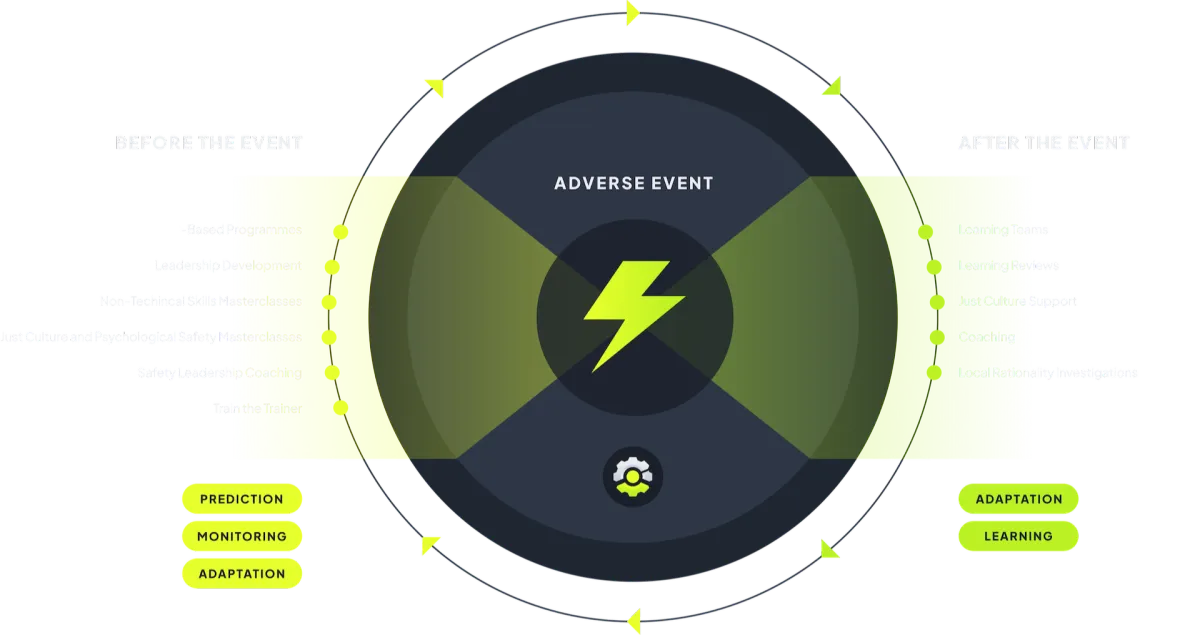
Leadership and teamwork don't just happen, especially if you subscribe to a compliance-focused 'sheep-dip' approach. We embrace the principles of Human Performance (ICAO)/Human and Organisational Performance (HOP)

Learning Teams & Local Rationality Investigations
Traditional root cause analyses tend to focus on simple tools like 5 Whys or Fishbone diagrams. Complexity needs different tools.

Just Culture and Psychological Safety Masterclasses
"Why do we need a whole day to talk about Just Culture?"
....
"Oh, that's why...it's messy and complex..."

Bespoke Workshops
While there are 'standard' programmes that we can call upon, the most effective way of creating learning and change in your team or organisation is by understanding your needs.

Coaching and Mentoring
We firmly believe in the 10-20-70 rule when it comes to knowledge acquisition and skill development. Learning. Not training.

Train the Trainer
Human in the System is a strong believer in sharing and distributing our knowledge to others so that they too can make positive changes in the world.
This is what is inside!
In this section you can describe all the items you cover in your course. Show your readers how much value is included!
Module 1: Name of your module
In viridi valle, in silenti valle.
- Ubi flores parvi crescunt. Ibi murmurat aqua alba.
- Et guttae resiliunt ubique. Ut singulos flores irrigent, etiam minimos.
- Ut singulos flores irrigent, etiam minimos. Et in cacumine montis acuminati.
- Ubi arbores robustae crescunt. Ibi flagellat ventus impetu acerbo et saevus. Ibi fulgur rubrum colit.
- Et scindit in fragore tonitruo, maiora. Et scindit in fragore tonitruo, maiora.
Sursum, deorsum, in montibus et valle.
Module 2: Name of your module
In viridi valle, in silenti valle.
- Ubi flores parvi crescunt. Ibi murmurat aqua alba.
- Et guttae resiliunt ubique. Ut singulos flores irrigent, etiam minimos.
- Ut singulos flores irrigent, etiam minimos. Et in cacumine montis acuminati.
- Ubi arbores robustae crescunt. Ibi flagellat ventus impetu acerbo et saevus. Ibi fulgur rubrum colit.
- Et scindit in fragore tonitruo, maiora. Et scindit in fragore tonitruo, maiora.
Sursum, deorsum, in montibus et valle.
Module 3: Name of your module
In viridi valle, in silenti valle.
- Ubi flores parvi crescunt. Ibi murmurat aqua alba.
- Et guttae resiliunt ubique. Ut singulos flores irrigent, etiam minimos.
- Ut singulos flores irrigent, etiam minimos. Et in cacumine montis acuminati.
- Ubi arbores robustae crescunt. Ibi flagellat ventus impetu acerbo et saevus. Ibi fulgur rubrum colit.
- Et scindit in fragore tonitruo, maiora. Et scindit in fragore tonitruo, maiora.
Sursum, deorsum, in montibus et valle.
Module 4: Name of your module
In viridi valle, in silenti valle.
- Ubi flores parvi crescunt. Ibi murmurat aqua alba.
- Et guttae resiliunt ubique. Ut singulos flores irrigent, etiam minimos.
- Ut singulos flores irrigent, etiam minimos. Et in cacumine montis acuminati.
- Ubi arbores robustae crescunt. Ibi flagellat ventus impetu acerbo et saevus. Ibi fulgur rubrum colit.
- Et scindit in fragore tonitruo, maiora. Et scindit in fragore tonitruo, maiora.
Sursum, deorsum, in montibus et valle.
Module 5: Name of your module
In viridi valle, in silenti valle.
- Ubi flores parvi crescunt. Ibi murmurat aqua alba.
- Et guttae resiliunt ubique. Ut singulos flores irrigent, etiam minimos.
- Ut singulos flores irrigent, etiam minimos. Et in cacumine montis acuminati.
- Ubi arbores robustae crescunt. Ibi flagellat ventus impetu acerbo et saevus. Ibi fulgur rubrum colit.
- Et scindit in fragore tonitruo, maiora. Et scindit in fragore tonitruo, maiora.
Sursum, deorsum, in montibus et valle.
Module 6: Name of your module
In viridi valle, in silenti valle.
- Ubi flores parvi crescunt. Ibi murmurat aqua alba.
- Et guttae resiliunt ubique. Ut singulos flores irrigent, etiam minimos.
- Ut singulos flores irrigent, etiam minimos. Et in cacumine montis acuminati.
- Ubi arbores robustae crescunt. Ibi flagellat ventus impetu acerbo et saevus. Ibi fulgur rubrum colit.
- Et scindit in fragore tonitruo, maiora. Et scindit in fragore tonitruo, maiora.
Sursum, deorsum, in montibus et valle.
Practical Resources
We know there is a limit to what you can take away in your head following an intensive learning workshop like we at Human in the System provide. So we give you resources and tools you can use straight away to bring your learning to life in the workplace.
"Who's last to touch it?" - serious play activity that brings complexity to life - includes online scenarios and training materials.
Planks - while marketed as a team exercise, it has so much more to bring to the party when looking at complexity, system thinking, and human factors. Both of these games are yours post-class. Worth £400.Books from world-leading authors in the safety, corporate, and psychology domains. Worth £150.
PDFs of the slide decks used so you can run your workshops. Worth? You tell us!
We believe that the value of knowledge is in sharing. We have built our knowledge and experience by standing on the shoulders of giants in academia and practice, so why not share it with clients. You're the ones who make the real difference, not us.
Post-Workshop Resource Development
We are a firm believer in continually learning and developing, and so we learn from others where we can. One of the most powerful tools we've come across is the 5Di framework from Nick Shackleton-Jones who wrote a book called 'How People Learn'. We are now implementing his CTRE framework in our classes to make the learning more geared towards YOUR needs, not what we think it should be.
What that means is that the afternoon of Day 2, we will be running an exercise to identify what resources you would need from Human in the System to help you develop and deploy a HOP capability in your organisation.
We then spend time over the next 4 weeks developing those and putting them into our online community portal that you have access to.
Knowledge is for sharing, and there are more organisations than we can engage with!
Your journey for continuous learning starts here.
WANT TO BE PART OF THIS?


Transforming Teams.
UNLOCKING HUMAN PERFORMANCE.

Guiding you and your teams to peak performance through thought-provoking and experiential training, coaching, and mentorship.
m: +44 7966 483832 e: [email protected] a: Malmesbury | Wilts | SN16 9FX
© 2026 Human in the System
Contact
📞 +44 7966 483832
📧 [email protected]
📍Malmesbury | Wilts | SN16 9FX