Resources

Everything here is built around one question: what do people need

to understand in order to perform well when it matters most?

Articles and Writing

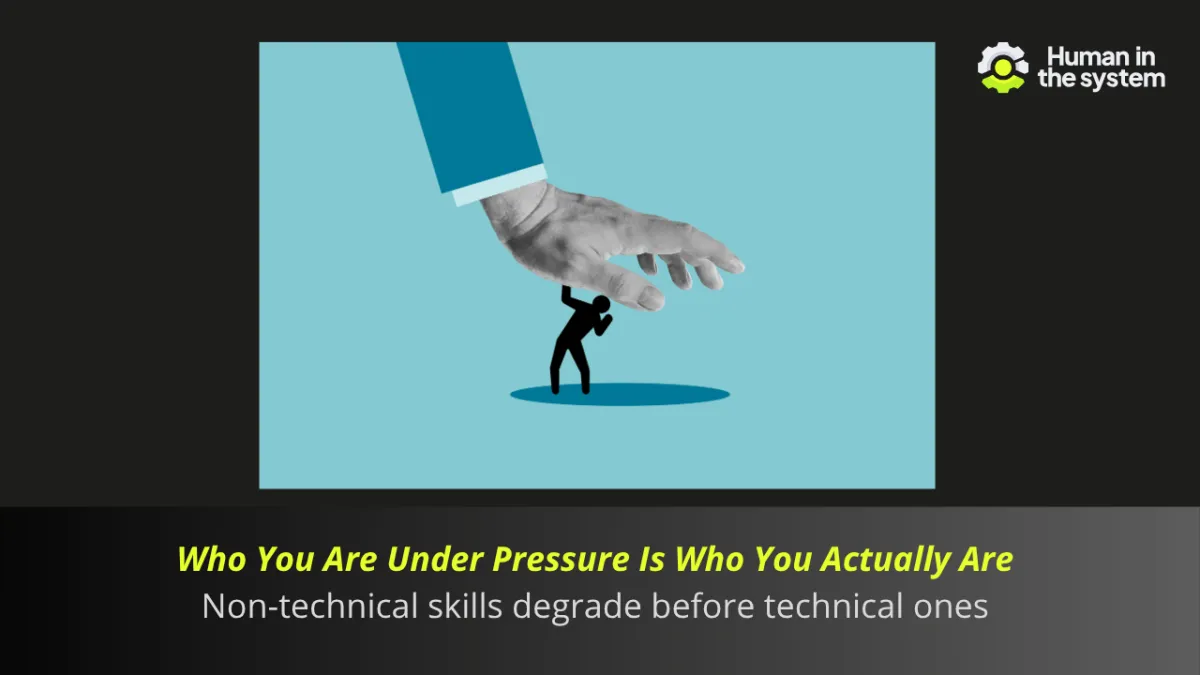
Who you are under pressure is who you actually are

Published on: 14/04/2026

Non-technical skills degrade before technical ones. Understanding this under comfort doesn't transfer. Be better than yesterday by practising — not just understanding — what good leadership looks like when pressure is real.
Podcasts and Audio

Videos

Free downloads

Building Psychological Safety in Your Team

This 10-page guide defines psychological safety as the shared belief that team members can speak up, ask questions, admit mistakes, and challenge decisions without fear of humiliation or punishment. It frames psychological safety as the bedrock of high-functioning teams, not a soft add-on, but a prerequisite for operational performance and learning.

PDF

UNITED-C Guide

This 14-page guide presents the brief as the primary mechanism through which a group of individuals becomes a team. It frames the briefing not as information transmission or administrative tidying, but as the structured conversation through which a shared mental model is built before the dive or task begins.

PDF

DEBrIEF Guide

This 14-page guide presents the debrief as a simplified investigation and one of the most powerful learning tools available to high-risk teams. It frames the debrief not as a post-task formality, but as the mechanism through which individual perceptions are calibrated into a shared understanding of how work actually went, and why.

PDF

Just Culture in Practice: Guide for Small Orgs

This 30-page guide presents Just Culture as a culture of trust, learning, and accountability, distinct from no-blame. It frames the response to unwanted outcomes not as a search for culprits, but as a structured enquiry into how the action made sense to the person at the time, given the conditions of the system around them.

PDF

Why don't workers use Stop Work Authority?

This 6-page briefing synthesises three studies showing that formal stop work schemes routinely fail because stopping carries real professional and social consequences for the worker who does it. It frames the failure not as a deficit of courage at the sharp end, but as a system design problem: the conditions around the policy determine whether it functions.

PDF

Speaking Truth to Power - It's not that simple

This 4-page briefing presents research across 3,600 employees showing that willingness to speak up drops sharply down the hierarchy, and that senior leaders consistently overestimate how well they listen. It frames silence at the front line not as a personal failure of courage, but as a rational response to the conditions managers have created around them.

PDF

WITH - Understanding Error Producing Conditions

This 4-page guide presents WITH as a structured framework for identifying the conditions that make errors more likely: Work environment, Individual characteristics, Task demands, and Human nature. It frames error precursors not as character failings to be overcome through diligence, but as observable features of a situation that accumulate, compound, and can be designed out.

PDF

LFEO/LEODSI Framework and Overview

This guide introduces Learning from Emergent Outcomes (LFEO) as a way of understanding how outcomes in diving actually emerge, using frameworks including LEODSI, PETTEOT, Just Culture, and the Work-as-Imagined / Work-as-Done gap. It frames incident review not as a search for the person who erred, but as a structured analysis of the system interactions that made the actions taken entirely logical at the time.

PDF

If you want the full picture, not just the reading list — start here.

Recreation & Technical

Recreational & Technical Diving

From open water to cave and rebreather, the gaps in your training are rarely technical. Your agency taught you what to do. We cover what happens when a team stops communicating, when a plan loses its flexibility, when no one says what they're thinking. That's where dives go wrong — and that's what we teach.

Commercial & Occupational

Commercial & Occupational Diving

Commercial diving operates inside management systems, risk registers, and permit-to-work frameworks. Those systems are necessary. They are also not sufficient. The human side — team dynamics, supervisor decisions, stop-work authority, normalisation of deviance/risk — is where your serious incidents will come from. We bridge the gap between your documented procedures and how work actually gets done.

Defence & Special Operations

Military Diving

Military diving teams operate at the intersection of technical complexity, operational pressure, and hierarchical culture. Power distance, mission focus, and the reluctance to report near-misses are systemic challenges, not individual weaknesses. Our programmes — drawn from military aviation and adapted for defence diving — address them directly, in the language of people who have served.