
Who you are under pressure is who you actually are
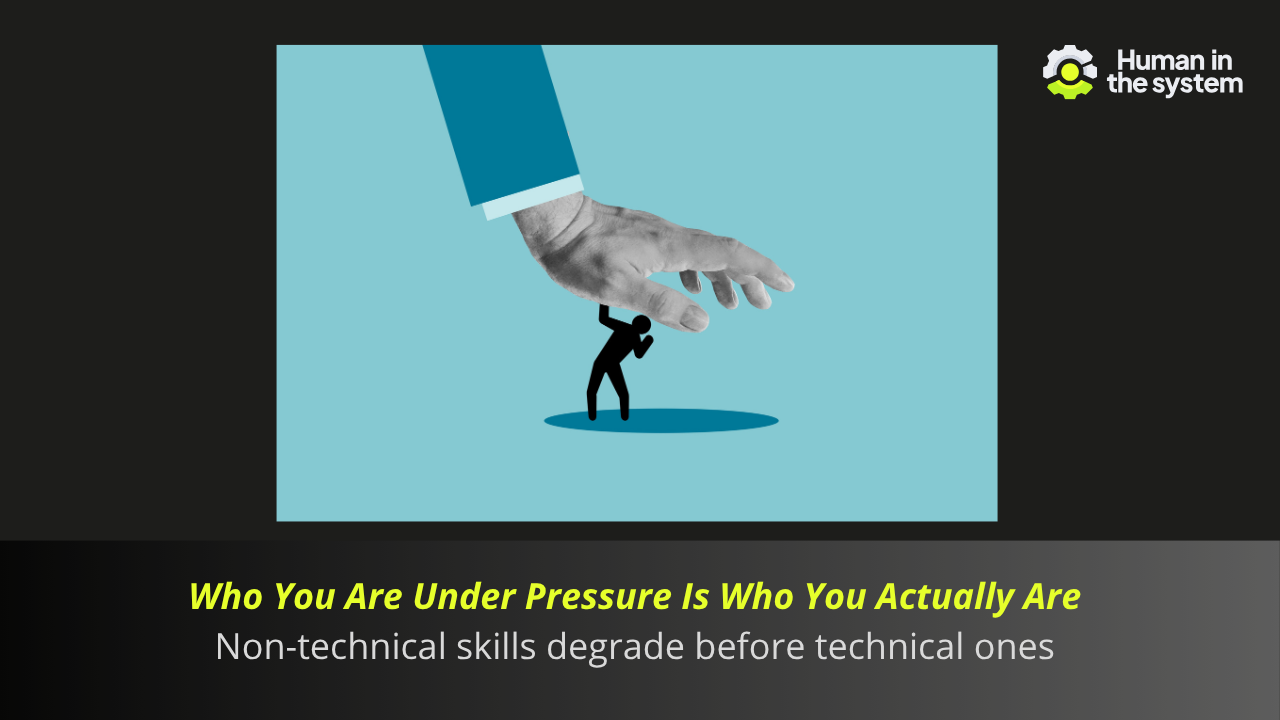
Non-technical skills degrade before technical ones — what leaders need to practise, not just understand, about performance under stress
There is a version of leadership development that is primarily conceptual. People learn frameworks, discuss case studies, understand principles, and leave with a clearer intellectual picture of what good leadership looks like. This version of development is useful and insufficient. The gap between understanding a principle and applying it under operational pressure is one of the most consistent findings in human performance research — and one of the most consistently underestimated by the organisations that invest in development.
The evidence from high-reliability industries is unambiguous on this point. Technical skills are relatively robust under stress. The engineer who knows how to diagnose a fault can typically diagnose the same fault under pressure. Non-technical skills — situation awareness, decision-making, communication, team leadership — degrade faster, degrade earlier, and degrade in ways that the person experiencing the degradation is often the last to notice.
Situation awareness, as defined by Mica Endsley, involves three levels: perceiving what is happening in the environment, understanding what it means, and projecting what will happen next. Under stress, the first level narrows — people attend to fewer cues. The second level becomes more rigid — people interpret what they see through a more fixed mental model. The third level becomes more short-term. The combined effect is a leader who is, under pressure, operating with less information, less flexibility, and a shorter time horizon than they would be operating with under normal conditions. This is precisely when the quality of non-technical performance matters most.
Under pressure, people do not rise to their training. They fall to it. The question is what the training was actually for.
Decision-making under time pressure follows similar patterns. Gary Klein's research on recognition-primed decision-making shows that experienced professionals under pressure rely heavily on the first option they recognise as workable. This is usually good — it is fast and often accurate. It is also susceptible to fixation: the situation that looks familiar but is crucially different, the first option that would have been right in nine previous cases but is wrong in this one. Fixation errors — remaining committed to a course of action or assessment in the face of contradicting information — are a consistent feature in the investigation of serious incidents across sectors.
Communication degrades predictably too. Under stress, people become more directive and less consultative. Briefings become shorter and contain less of the reasoning behind decisions. Confirmation-seeking replaces genuine inquiry. The team member with critical information may have it but not surface it, because the communication climate of the team has narrowed to match the pressure.
The implication for development is that understanding these patterns is necessary but not sufficient. What builds genuine non-technical skill under pressure is practice in conditions that approximate the pressure itself — simulation, scenario training, debriefed exercises that create the cognitive and social demands of real operational stress. The armed forces and commercial aviation have understood this for decades. High-fidelity simulation with structured debriefing is the standard development method precisely because the research on skill transfer is clear: you develop performance under pressure by practising under pressure.
Most non-aviation, non-military organisations have not yet made this investment at the leadership level. They train technical skills in realistic conditions and non-technical skills in comfortable ones. They then discover, during actual crises, that the comfortable training did not transfer.
Knowing what psychological safety means is not the same as maintaining it under schedule pressure. Understanding crew resource management principles is not the same as applying them when a senior colleague is making what you believe is a dangerous decision. The practice is the point. Without it, the understanding stays in the classroom.


