
Be Better Than Yesterday
Just Culture in Practice
Online Companion Course
The companion course. Ninety minutes that changes what happens after something goes wrong.
You have the guide. This course helps you use it. Seven short modules take you from the first question you ask after a near miss, through a structured eight-question review, to the follow-up that shows your team the report was worth making. Built for people who lead small teams in high-risk work and who do not have a safety department to hand the problem to.

Recreation & Technical
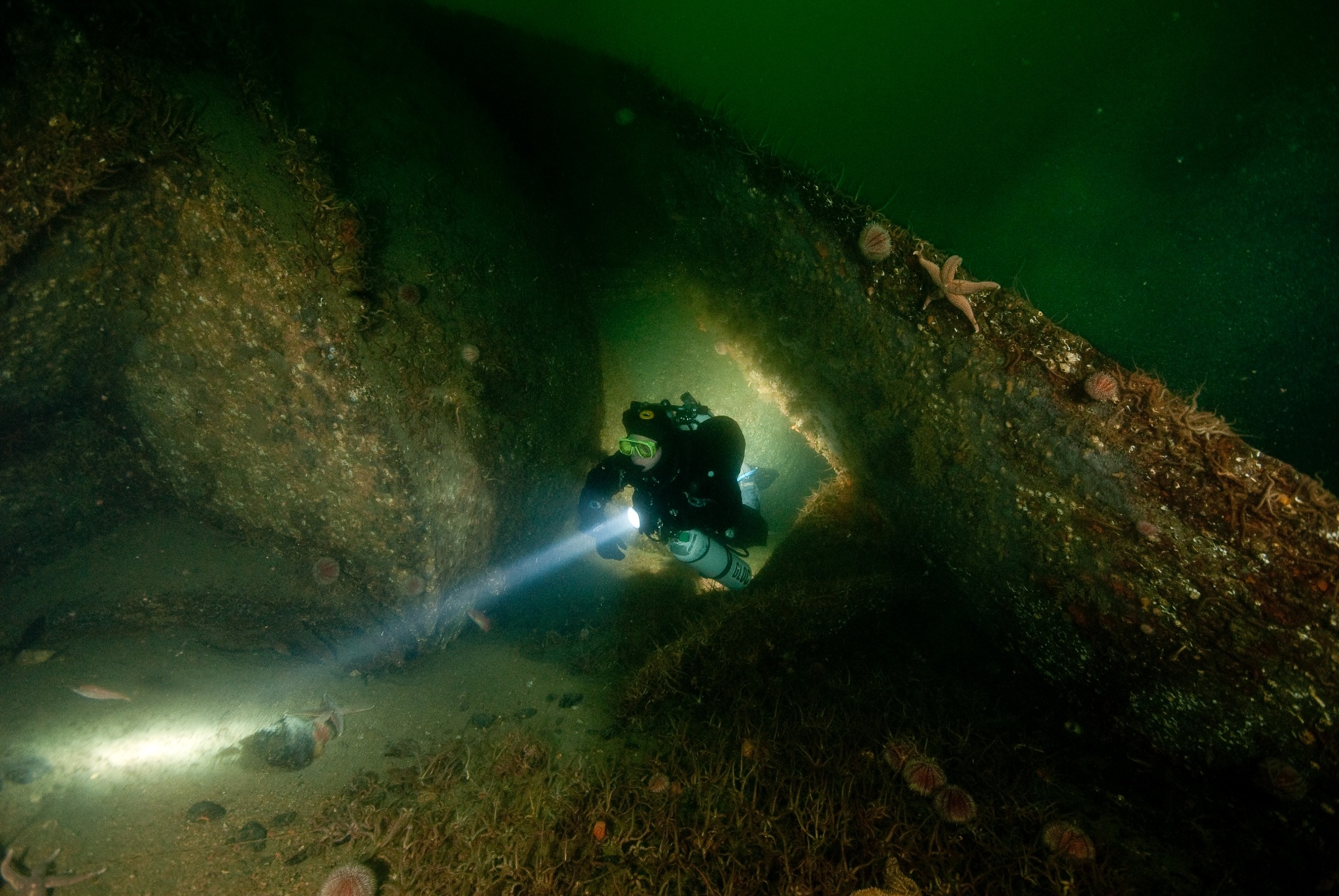
Recreational & Technical Diving
From open water to cave and rebreather, the gaps in your training are rarely technical. Your agency taught you what to do. We cover what happens when a team stops communicating, when a plan loses its flexibility, when no one says what they're thinking. That's where dives go wrong — and that's what we teach.
Commercial & Occupational
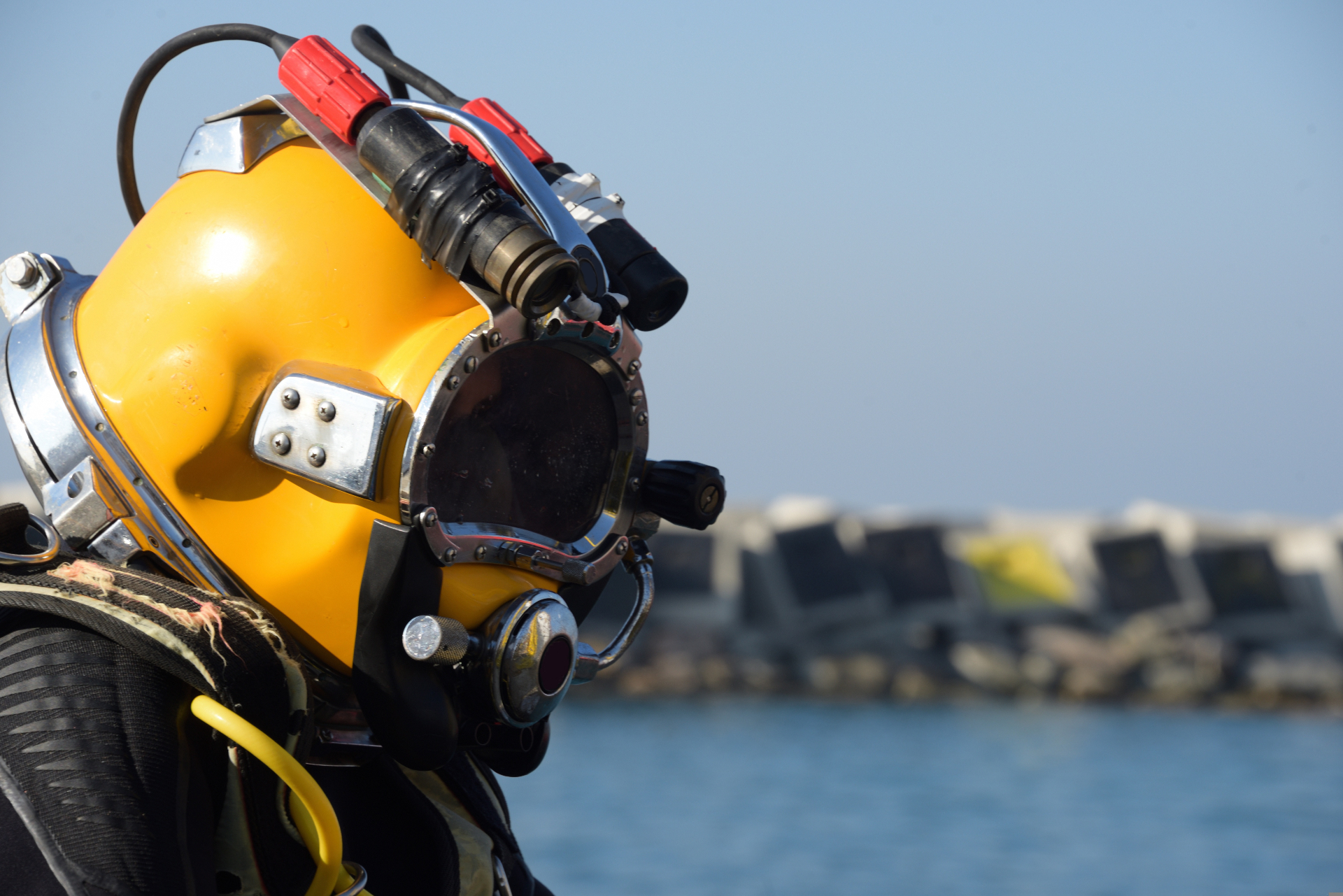
Commercial & Occupational Diving
Commercial diving operates inside management systems, risk registers, and permit-to-work frameworks. Those systems are necessary. They are also not sufficient. The human side — team dynamics, supervisor decisions, stop-work authority, normalisation of deviance/risk — is where your serious incidents will come from. We bridge the gap between your documented procedures and how work actually gets done.

Defence & Special Operations
Military Diving
Military diving teams operate at the intersection of technical complexity, operational pressure, and hierarchical culture. Power distance, mission focus, and the reluctance to report near-misses are systemic challenges, not individual weaknesses. Our programmes — drawn from military aviation and adapted for defence diving — address them directly, in the language of people who have served.
Who is this for?
Owner-operators and supervisors
Your management system already tells you to investigate. What it rarely gives you is a repeatable method that surfaces the conditions rather than the culprit. Without one, two supervisors can look at the same shortcut and reach different conclusions, and your team learns that the outcome depends on who was on shift. The Eight-Question Review gives you consistency you can defend and a record you can act on.
Team leads and safety managers
Small teams have short reporting chains and no anonymity. Everyone knows who was involved before the report is written, and power distance is felt in every conversation. That makes the first sixty seconds after an event more consequential than any policy you publish. This course focuses on what you say, in what order, and what happens in the days that follow.
Instructors and centre managers
When a student is injured, or nearly is, you are the one who has to work out what happened and decide what to do about it. You are also the person who signs the paperwork and answers to the agency, the parents, and the insurer. Those roles pull in different directions. This course gives you a way to run the learning conversation first, so you understand the conditions before you make any decision about competence or standards.
The same near miss keeps coming back.
You talked about it. Everyone agreed it should not happen again. Six weeks later something very similar lands on your desk, and you start wondering whether the team is listening.
Usually they are. What has happened is that the review went looking for a person instead of a condition. Once the first question sounds like a verdict, people edit what they tell you. You get the tidy version, not the one with the workaround, the time pressure, and the near misses that never got written down. Reporting drops, the dashboard stays green, and it starts to look like the risk has gone away when it has only gone quiet.
The gap is not commitment. It is method. Most leaders in small organisations have never been given a consistent, defensible way to review an event that keeps learning and accountability in the right order.
Just Culture in Practice Guide and Companion Course
A review you can run in the real world, under time pressure, without turning it into a blame hunt. This course takes the tools from the Just Culture in Practice guide and shows you how to use them on a live event. You practise on scenarios before you use it on your own team, so the first time you run it for real is not the first time you have run it.
The stance - Local rationality and psychological safety, explained in plain terms. Why "How did it make sense?" gets you a complete account and "Who failed?" gets you a defensive one.
The method — The Eight-Question Review, walked through in order from system to individual. You learn when to stop, how to run the substitution test properly, and why intent comes last.
The follow-up — Every finding gets an owner, an action, and a date. A five-minute slot at the next team meeting closes the loop, protects the individual, and shows the team that reporting leads somewhere.
Seven modules. Ninety minutes total. Self-paced, so you can take it in short blocks between jobs.
Problem-based, not lecture-based
Each module introduces only what you need, then puts it straight to work in a short scenario. You spend more time deciding than listening. Downloadable tools are provided as you work through the course to make it easier to do the right thing post class.
Module 1: Set the stance. How context shapes behaviour, and the two moments when psychological safety decides what you find out.
Module 2: Human error and the zero-harm tension. How to hold an ambitious standard without turning it into a promise that drives concealment.
Module 3: Language that drives learning. Six blame-leaning openers, rewritten. Practical swaps you can use this week.
Module 4: Foundations for small organisations. The six conditions that have to exist before any review tool will work, plus a two-minute readiness snapshot.
Module 5: The Eight-Question Review. Q1 to Q8 in sequence, with the three preparatory rules and the traps that undo the method.
Module 6: Guided practice. Run the full review on a scenario, draft your findings, then compare your reasoning against a model answer.
Module 7: From findings to action. Owners, timeframes, feedback loops, and a quarterly cadence that keeps actions from vanishing.
What you get
The Eight-Question Review card
A one-page reference for Q1 to Q8 that you can print, laminate, and keep in the office. Designed to be used on shift, not filed.
Near-miss report template & review log
Two lightweight tools that make reporting the easiest option and stop actions disappearing. Seven fields each, no names required.
Worksheet and model answer pack
Run a real event through the same worksheet used in the guided practice, then check your reasoning against a worked example.
Foundations starter checklist
A one-page setup list for the next seven days, so the tools land in a system that can hold them.
Language cards
Short, ready-made phrases for the moments that are hardest to get right: the first response after a report, and the team briefing that follows.
Built by someone who has run the enquiries
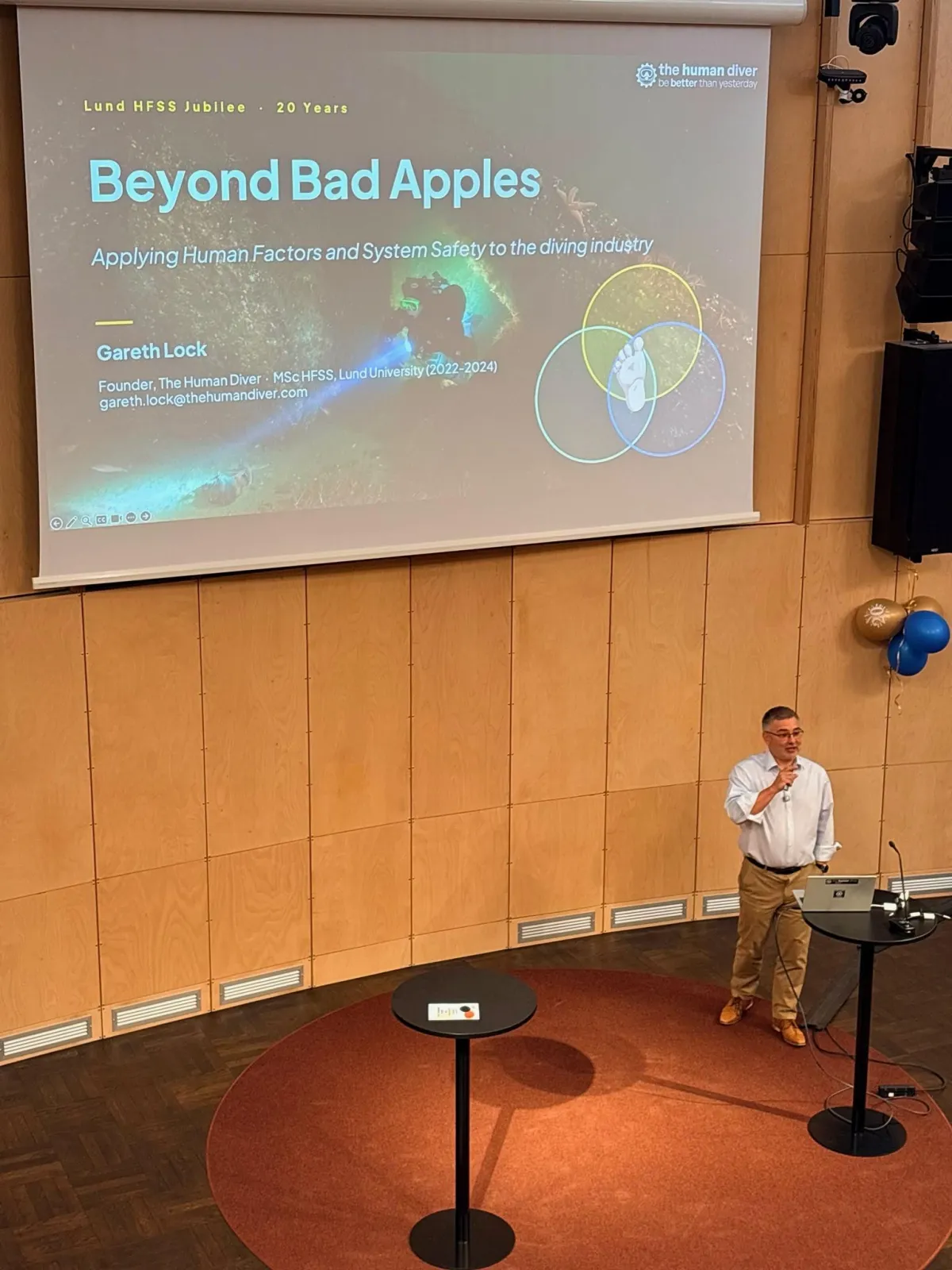
This course is developed by Gareth Lock, founder of Human in the System and The Human Diver. His work applies human factors, non-technical skills, and Just Culture to high-risk operations across military and commercial diving, construction, energy, and healthcare.
Gareth holds an MSc in Human Factors and System Safety from Lund University, where his research examined how storytelling drives organisational learning. Before that he spent 25 years in the Royal Air Force. He has led fatal diving accident enquiries for the UK Ministry of Defence and the New Zealand Defence Force, and he is the author of Under Pressure and the Just Culture in Practice guide, and producer of the documentary If Only.
The course draws on the foundational work behind the field, including Dekker, Reason, Hollnagel, and Edmondson, and translates it into something a team lead can use on a Tuesday afternoon with fifteen minutes and a shaken crew.
What you'll be able to do
Run the Eight-Question Review on a real near miss
Separate the learning review from any accountability process
Ask a first question that opens the account rather than closing it
Apply the substitution test without leading your peers
Write findings in system language, anchored to evidence
Tell the difference between a signal and a finding
Explain "zero harm" without promising perfection
Turn findings into owned actions with dates
Spot the themes across a quarter, not just the events
Close the loop with your team while protecting the individual

Simple, accessible pricing
$19 - that's it.
The 30-page Just Culture in Practice guide
Seven self-paced modules
All downloadable tools and templates
Worksheet and model answer pack
Lifetime access
Part of an organisation, and want to bulk buy?
Questions?
Do I need the guide to take the course?
No. The course works on its own and includes the tools you need. The guide gives you more depth on each foundation and is useful if you are setting up a reporting and review system from scratch. The guide is available in the first module though.
How long does it take?
Ninety minutes of seat time, split into short modules. Most people take it across two or three sittings rather than in one go.
Is this just "no blame"?
No. Just Culture is trust, learning, and accountability together. The course is explicit that some behaviour crosses a line, and Q7 and Q8 in the Eight Question Review (8QR) exist for exactly that. The point is to reach that question in the right order and with actual evidence, rather than starting there.
Our organisation is tiny. Is this still relevant?
It was written for small organisations specifically. In a team of six, the same person is often the investigator, the manager, and the friend. The course deals with that directly, including how to create real separation between learning and discipline when you cannot separate the people.
What if I am not in diving? (I know Gareth as 'The Human Diver')
The method is domain-neutral. The scenarios are drawn from generic high-risk work: isolation, handover, forklift movements, verification steps. Learners from rescue, engineering, and occupational settings use the same Q1 to Q8 sequence without adaptation.
Can we run this across a leadership team?
Yes, and it works better when you do, because consistency between reviewers is one of the hardest problems to solve. If you want calibration across several leaders, we also run a day-long face-to-face session for deeper practice and facilitation skills.
What happens next?
People do not decide to speak up because of your policy. They decide based on what happened last time someone did.
Ninety minutes gives you a method you can use for the rest of your career, and a way of responding that makes the next report more likely, not less.
Human in the System
Be Better Than Yesterday