
WITH — understanding the conditions that shape performance before something goes wrong
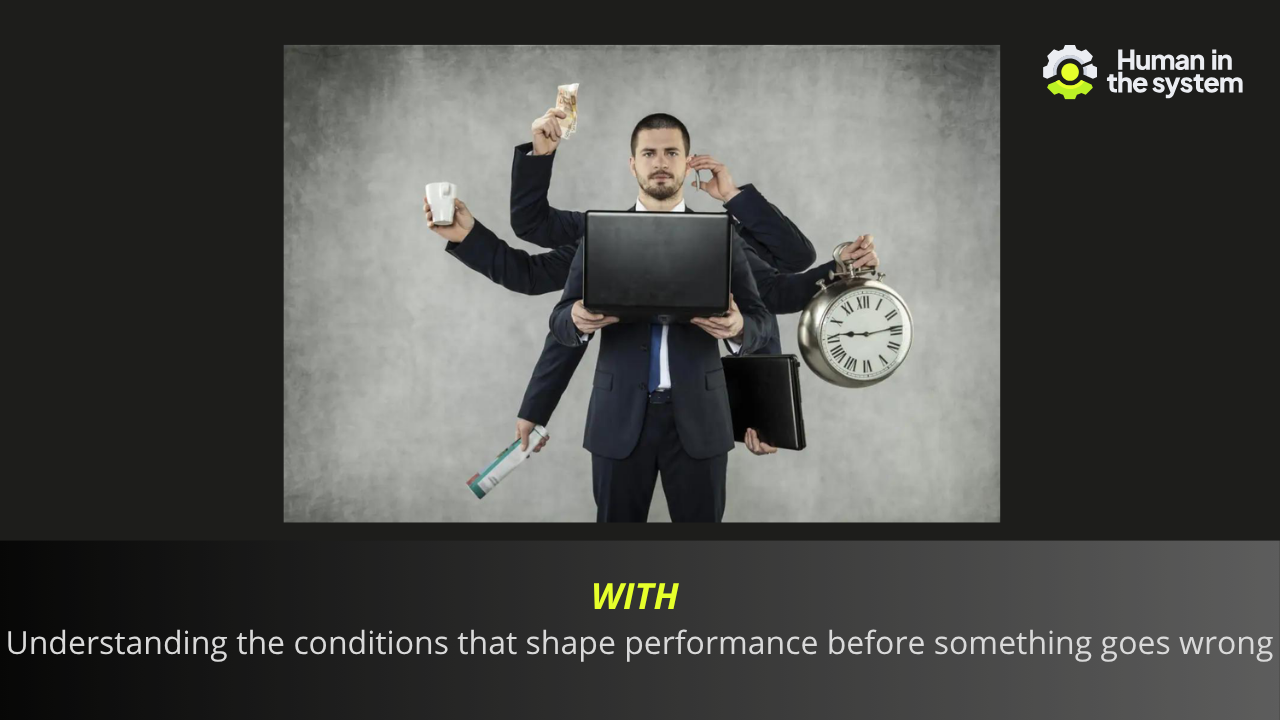
Most pre-task safety conversations in high-risk organisations follow a predictable structure: hazard identification, control measures, task allocation, signatures. This is necessary. It is also, on its own, insufficient. What it typically fails to surface is the set of conditions — in the environment, in the task, in the team, in shared human nature — that will shape how performance actually unfolds. The WITH framework exists to fill that gap.
WITH stands for Work environment, Individual characteristics, Task demands, and Human nature. These four lenses cover the categories of conditions that, when present in combination with a critical or high-consequence action, make errors more likely. Crucially, none of them are character judgements. They are observable features of a work situation that can be anticipated, named, and — where possible — designed out or mitigated before the task begins.
Error precursors do not cause harm by themselves. They create the conditions in which a specific action or decision is more likely to produce an unwanted outcome. WITH makes those conditions visible before the action is taken.
W — Work environment
The physical and organisational conditions surrounding the task. Distractions, interruptions, departures from expected routine, confusing equipment layout, degraded instrumentation, workarounds that have become informal norms. The key question: what in the environment is creating competition for attention, or creating conditions in which the task is harder than it was designed to be?
I — Individual characteristics
The current state and background of the people doing the work. Fatigue, illness, unfamiliarity with the specific task or equipment, limited recent practice, knowledge gaps, communication style differences that could affect team function. These are factors to understand and plan for — not traits to assign blame to. The key question: who is doing this work, and what do we need to know about their current state to plan the task well?
T — Task demands
The inherent complexity of what is being asked. Time pressure, high cognitive load, simultaneous or sequential actions, repetitive elements that invite routine drift, irreversible or high-consequence steps, ambiguous goals or standards. The key question: what does this task demand of the people performing it, and does the current situation — staffing, time, conditions — provide adequate resource to meet those demands?
H — Human nature
The shared cognitive features that all of us carry into every task: stress narrowing attention, habit patterns running without conscious oversight, assumption-making under uncertainty, complacency following repeated success, mental shortcuts, and limited working memory. These are not weaknesses of particular individuals. They are features of human cognition that no amount of training eliminates. The key question: which of these normal human tendencies is most likely to be triggered by this specific task in these specific conditions?
Applying WITH in practice
WITH is most useful when it becomes a shared language rather than a form to be completed. A five-minute pre-task conversation using the four lenses surfaces conditions that no individual would have flagged alone, and it creates shared situational awareness before the point where communication becomes difficult. When reviewing an incident, mapping the WITH factors that were present shifts the conversation from 'who erred' to 'what conditions were present' — which is where systemic learning begins.
The framework also provides a language for shifting from old-view to new-view framing: from 'they were complacent' to 'repeated success without consequence reduced perceived risk'; from 'they cut corners' to 'workarounds had become the local norm'. That shift in language is not about removing accountability. It is about placing it where it will produce change.
↓ Download: WITH reference card — four lenses, worked example, old/new view language guide


