
The hierarchy in the room
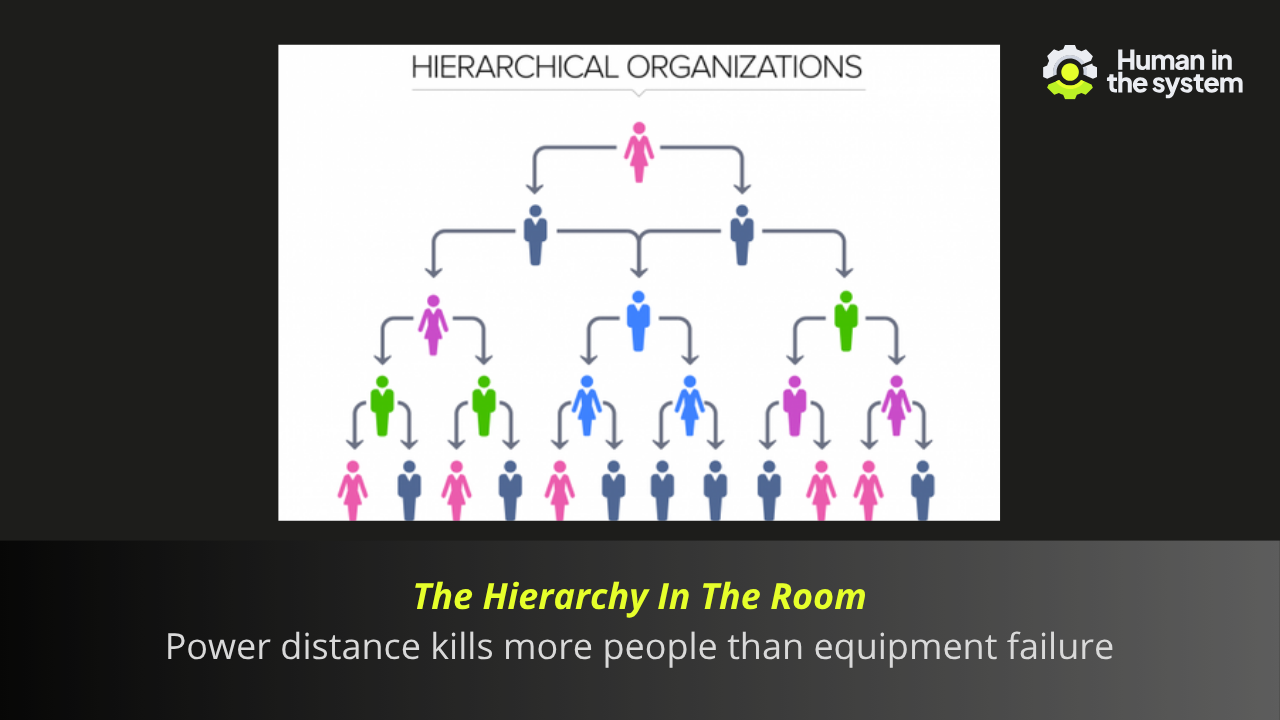
Power distance kills more people than equipment failure — how deference to authority operates invisibly and what leaders must actively dismantle
In 1977, two Boeing 747s collided on the runway at Tenerife Airport in what remains the deadliest accident in aviation history. 583 people died. The technical cause was a take-off attempted in fog without clearance. The human cause was more complex and more instructive: the co-pilot of the departing aircraft had expressed reservations. He had communicated uncertainty. He had not, in the moment that mattered, directly challenged the captain's decision. Subsequent analysis of the cockpit voice recording makes clear that he had the information needed to prevent the crash. The social dynamics of the cockpit made using that information feel impossible.
Geert Hofstede's research on cultural dimensions identified power distance as one of the most significant variables in organisational behaviour — the degree to which less powerful members of an institution accept and expect that power is distributed unequally. In high-power-distance environments, deference to authority is not a character flaw. It is a trained, socially reinforced response that is often rational within its own logic. The junior person who challenges the senior person takes a risk. The risk is social, professional, and sometimes physical. In contexts where that risk has historically been real, deference becomes survival strategy.
Hierarchy does not have to instruct people to stay silent. It simply has to make speaking up feel like the more dangerous option.
Aviation's response to this problem — crew resource management, developed in the late 1970s and 1980s following a series of accidents attributable to authority gradients — is one of the most studied and most instructive interventions in the history of occupational safety. The core insight was that technical competence was not the limiting factor in cockpit safety. Communication, assertiveness, and the willingness of junior crew to challenge senior crew were. The solution was not to reduce hierarchy — it was to explicitly train both sides of the authority relationship in how to manage it.
This lesson has transferred imperfectly to other sectors. Healthcare has begun to engage with it seriously, particularly in surgical teams, where research consistently shows that nurses and technicians observe errors that surgeons miss, and that the majority do not speak up. Construction and energy have made progress in policy terms — stop-work authority, speak-up campaigns — but less progress in the cultural conditions that determine whether those policies are used.
The reason is that power distance is not primarily addressed by policy. It is addressed by behaviour — specifically, by the consistent behaviour of those at the top of the hierarchy. When a senior figure responds to challenge with defensiveness, the lesson learned by everyone who observes it is that challenge is unsafe. When a senior figure explicitly invites challenge, acts on it, and thanks the person who raised it, the lesson is different. These behaviours are not large gestures. They are moments, repeated across hundreds of interactions, that cumulatively define what is normal.
For leaders who genuinely want to reduce power distance in their organisations, the practical work is personal before it is structural. It starts with an honest question: how do people around me actually experience raising a concern? Not how do I intend it to feel, but how does it land? The answer, sought genuinely rather than rhetorically, usually identifies specific behaviours that need to change.
The hierarchy in the room does not announce itself. It operates through what people calculate, silently, about the cost of speaking up. Dismantling it requires leaders who understand that calculation and who work, consistently, to change it.


