
What you model matters more than what you mandate
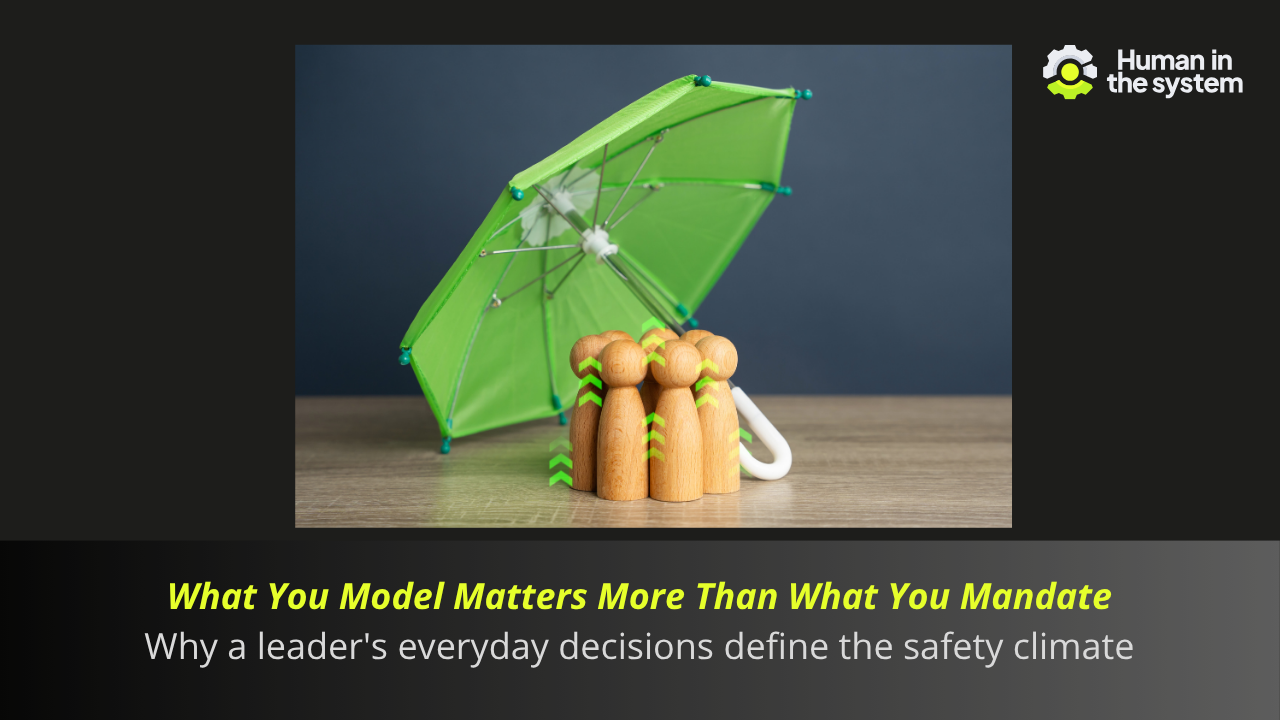
Why a leader's everyday decisions about time, attention, and response to failure define the safety climate
Every organisation has a formal safety culture — the one described in the policies, communicated in the inductions, and measured in the annual survey. Most organisations also have an informal safety culture — the one that is understood by every experienced worker and communicated through observation rather than documentation. The relationship between these two cultures is the most important indicator of how an organisation will actually perform under pressure.
When the formal and informal cultures are aligned — when the behaviour of leaders in practice matches the values stated in policy — people can trust the system. When they are not aligned, people trust the informal culture, because the informal culture is the real one. The new employee quickly learns that the stated commitment to raising concerns without fear does not apply when concerns are inconvenient. The worker who sees a senior figure bypass a procedure learns that procedures apply to some people more than others. These lessons are never taught explicitly. They are absorbed through observation, and they are absorbed quickly.
Edgar Schein, whose work on organisational culture remains foundational, argued that culture is primarily transmitted through what leaders pay attention to, how they react to critical incidents, and how they model behaviour. Not through what they say at all-hands meetings. Not through values statements. Through the thousands of small decisions they make daily about where to spend time, what to reward, what to ignore, and how to respond when things go wrong.
Your people do not listen to what you say about safety. They watch what you do when safety conflicts with schedule, budget, or relationship.
The moments that define safety culture are not the ceremonial ones. They are the operational ones. The site manager who walks past an unsafe condition without comment because the job is behind schedule. The operations director who responds to a delay caused by a safety hold with irritation rather than support. The senior leader who asks "why didn't you just get it done?" when a worker exercised caution. Each of these moments, observed by the people around them, updates the informal understanding of what the organisation actually values.
This places significant burden on leaders, and it is worth being honest about that. The demand is not for perfection. It is for consistency — for a reliable pattern of behaviour that people can use to calibrate what is actually expected of them. A leader who occasionally slips but who demonstrably takes safety seriously will build a different culture than one who consistently prioritises production and occasionally performs safety commitment. The pattern matters more than any individual act.
The research on safety leadership consistently identifies a cluster of behaviours that distinguish high-performing organisations from others: visible commitment through physical presence in the work environment, genuine engagement with workers about operational realities, consistent response to safety concerns that prioritises understanding over blame, and personal modelling of the behaviours expected of others. None of these are complicated. All of them require sustained attention under the competing pressures of operational life.
The organisations that develop strong safety cultures do not do so through better policies or more comprehensive training. They do so because their leaders have internalised the understanding that safety is not a programme to be managed but a product of everyday behaviour — their own behaviour, observed, interpreted, and acted upon by every person in the organisation.
You cannot mandate your way to a safe culture. You can model your way there, one decision at a time.


