
Just culture is not no-blame culture
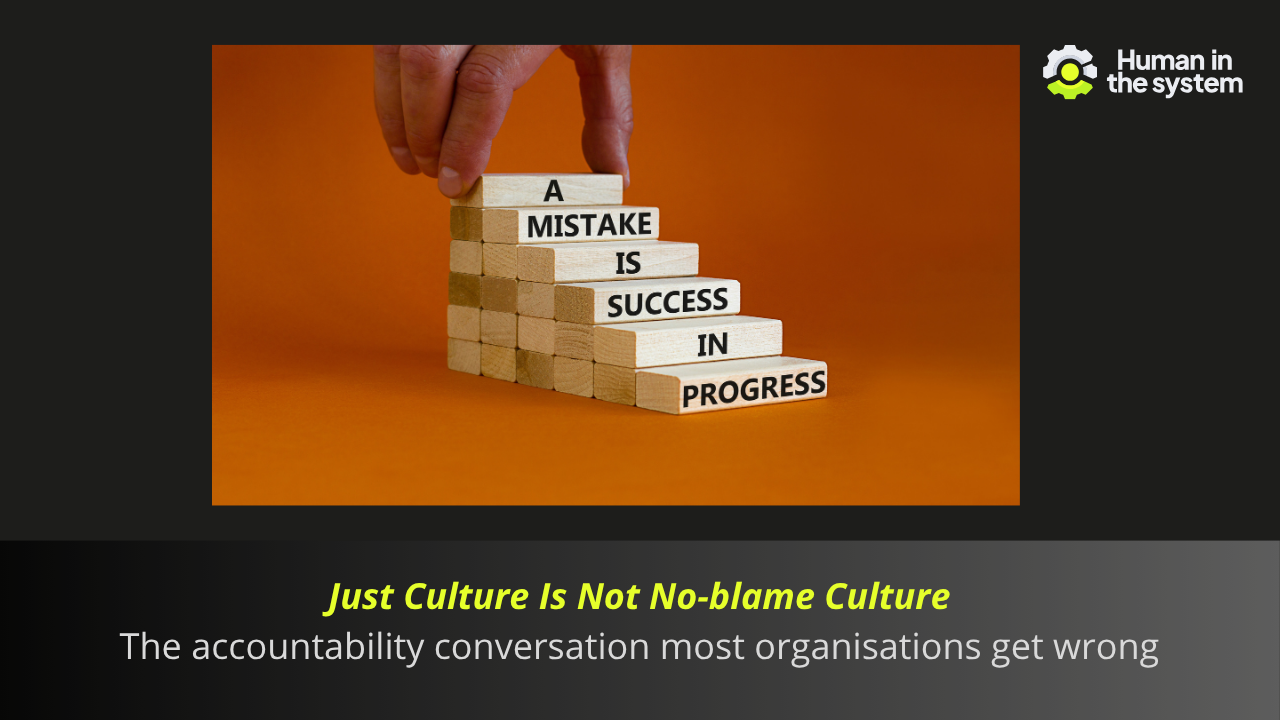
The accountability conversation most organisations get wrong — and why culpability and learning are not opposites
The phrase "no-blame culture" has done considerable damage to serious thinking about accountability in high-risk organisations. It is meant to convey something important: that punishing individuals for honest errors creates the conditions for silence, and silence creates the conditions for repeated failure. This is true. The conclusion that has sometimes been drawn from it — that accountability has no role in a safe culture — is not.
Sidney Dekker's work on just culture offers a more precise framework. A just culture is not the absence of accountability. It is a culture in which the response to human error is calibrated to its nature, and in which accountability is placed where it will actually produce change. This requires distinguishing between different kinds of acts: genuine errors, in which a person did what seemed reasonable given the information and conditions available; reckless behaviour, in which risk was taken knowingly without justification; and deliberate violations, in which rules were intentionally broken.
The vast majority of events in high-risk industries involve the first category. People make reasonable decisions that turn out to be wrong, in conditions where the right decision was not obvious, under pressures that the organisation helped to create. Treating these events as disciplinary matters is both unjust — in the literal sense of applying punishment disproportionately — and counterproductive. It teaches the workforce not to report, not to discuss, and not to contribute to organisational learning.
A just culture asks not just what the individual did, but what the organisation did to create the conditions in which that choice seemed reasonable.
Dekker's restorative approach adds a further dimension. Rather than asking only "what rule was broken and what is the appropriate sanction?", it asks "who has been affected by this event, what do they need, and what does the organisation need to learn?" This reframes the purpose of the response. It is not primarily punitive. It is primarily reparative and generative — aimed at restoring trust, supporting those affected, and building understanding that prevents recurrence.
This does not mean that serious misconduct or reckless behaviour goes without consequence. It means that the organisation's first question when something goes wrong is analytical, not prosecutorial. What happened? What conditions made it happen? What needs to change? The answers to those questions determine what response is appropriate — which will sometimes include individual accountability and will almost always include systemic change.
The practical challenge is that most organisations' HR and legal frameworks are built around a very different model. Incident response processes are designed for liability management, not learning. Investigation procedures are designed to establish fault, not to understand systems. The people who conduct investigations are trained in the former and rarely in the latter. Building a genuinely just culture therefore requires not just a change in rhetoric but a change in the structures and competencies that shape what happens after something goes wrong.
This is achievable. Organisations across aviation, healthcare, and increasingly industrial settings have developed investigation and response processes that are both rigorous and genuinely oriented toward learning. The common features are trained investigators who understand systems thinking, response frameworks that separate learning from disciplinary processes, and visible leadership commitment to protecting those who report honestly.
Just culture is harder to build than no-blame culture. It requires more sophistication, more consistency, and more courage from leaders who must sometimes sit with the discomfort of shared responsibility. What it produces — an organisation where people trust that honesty is safer than silence — is worth considerably more.


