
Five things high-reliability organisations do that yours probably doesn't
Weick and Sutcliffe's HRO framework applied — what it actually looks like in practice across your sector
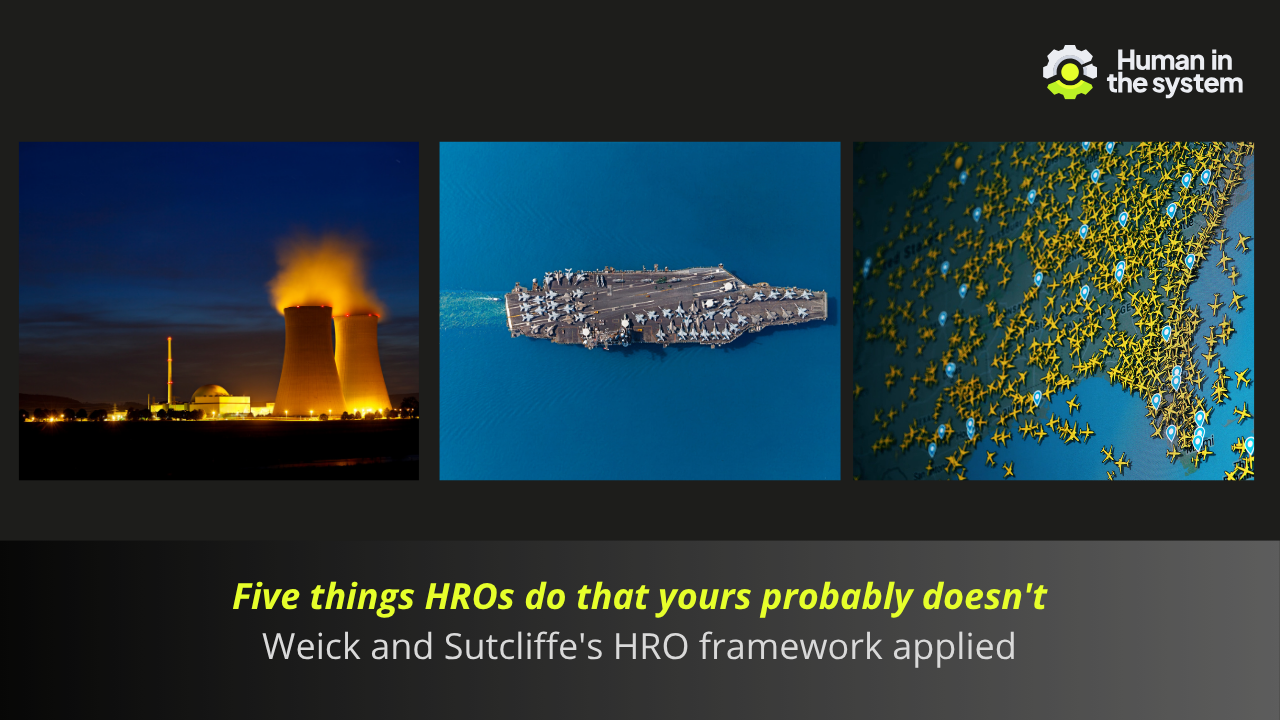
High Reliability Organisations is a term that appears frequently in safety literature and less frequently in operational practice. It refers to organisations that manage to operate in high-hazard, high-complexity environments — nuclear power, commercial aviation, aircraft carriers, some healthcare settings — with remarkably low rates of serious incidents, not because the hazards are lower but because the way these organisations function is different.
Karl Weick and Kathleen Sutcliffe's research identified five characteristics that distinguish HROs from organisations that, under similar external conditions, experience more frequent and more serious failures. These are not aspirational values. They are specific, observable behavioural and structural features that can be assessed, developed, and maintained. Here is what they look like in practice — and what their absence looks like in the organisations that most commonly lack them.
Preoccupation with failure
HROs treat near misses, anomalies, and small deviations as signals rather than noise. They do not wait for serious incidents to trigger learning. They actively seek out the weak signals that indicate something in the system is not functioning as intended. In practice, this means near-miss reporting systems that are actually used, that generate responses, and whose results are shared — not filed. Organisations that lack this characteristic typically have reporting systems with low uptake, or high uptake that generates no visible response. The message received is that reporting is performative.
Reluctance to simplify
HROs resist the temptation to reduce complex situations to simple explanations. They maintain diversity of perspective, actively seek out dissenting views, and are suspicious of consensus that arrives too quickly. In practice, this means decision-making processes that explicitly invite challenge, investigation processes that resist the pull toward single-cause explanations, and leadership cultures where the person who says "wait, I think it might be more complicated than that" is thanked rather than marginalised. Organisations that lack this characteristic tend to produce investigations that find a root cause and stop.
Sensitivity to operations
HROs maintain accurate awareness of what is actually happening at the operational level, in real time. Senior leaders have genuine understanding of front-line conditions, not the filtered, aggregated version that appears in management reports. In practice, this means regular, genuine engagement with work as it is done — not managed tours but actual conversations with the people doing the job. Organisations that lack this characteristic often discover, when something goes wrong, that the picture they had of operations was significantly different from the reality.
HROs are not accident-free by luck or by exceptional people. They are accident-resistant by design — and the design is learnable.
Commitment to resilience
HROs invest in the capacity to respond effectively when things go wrong, not just in preventing things from going wrong. They practise their response to unexpected events, develop the capability to improvise under pressure, and maintain resources — human, informational, and material — that can be deployed when the situation deviates from the planned. In practice, this means simulation, scenario training, exercises that test not just technical response but coordination, communication, and decision-making under stress. Organisations that rely solely on prevention, without developing response capability, discover its absence under the worst conditions.
Deference to expertise
HROs move decision-making authority to wherever the relevant expertise exists in the moment, regardless of formal hierarchy. The person with the most pertinent knowledge for the situation at hand has authority to act on it — and this is understood and supported by those above them in the formal structure. In practice, this means stop-work authority that is genuinely exercised, escalation protocols that are followed without cost, and a cultural norm that treats the most informed person rather than the most senior person as the appropriate decision-maker when the two diverge. Organisations that lack this characteristic experience the consistent suppression of operational intelligence by hierarchical norms.
None of these five characteristics are impossible to develop. None require exceptional people or unlimited resources. All of them require sustained, consistent leadership commitment to the kind of organisation that learns before it has to.
The question is not whether your organisation can become more like an HRO. It is whether it is willing to.


