
The expert blind spot
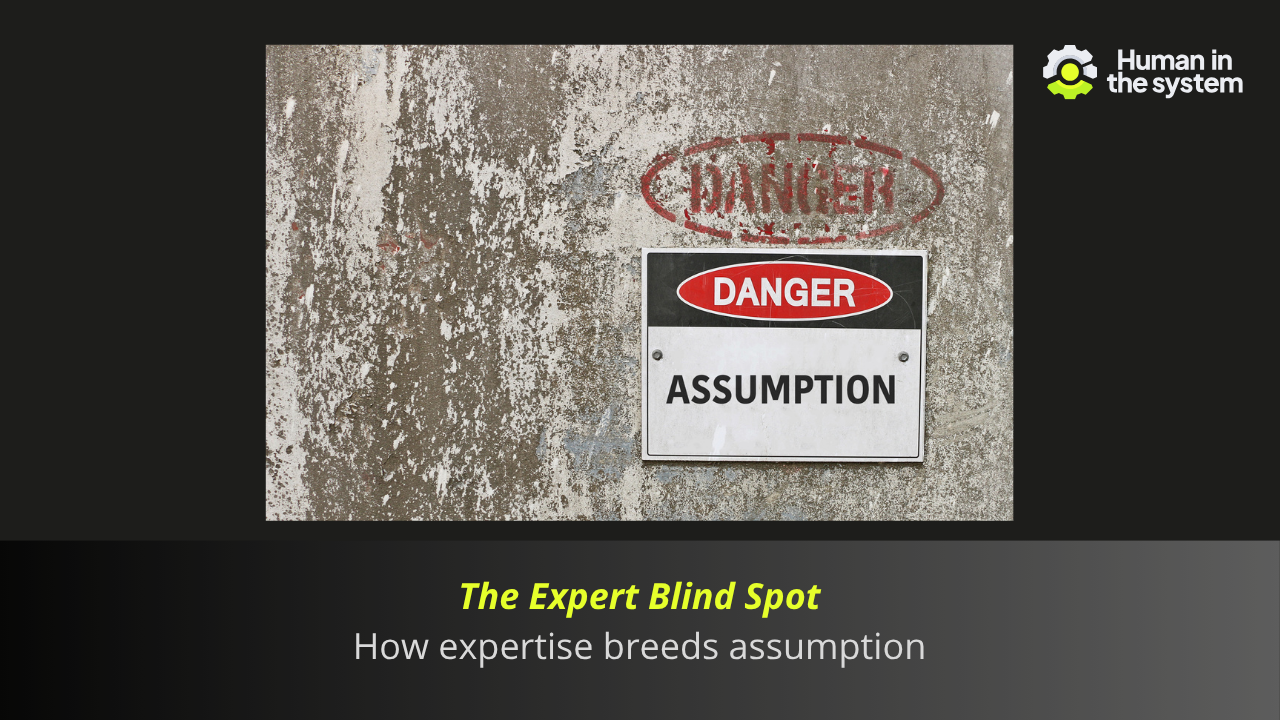
How expertise breeds assumption, assumption breeds drift, and experience can become an organisation's most underappreciated risk
Expertise is one of the most valuable things an organisation can accumulate. Experienced workers and leaders carry knowledge that is genuinely irreplaceable — tacit understanding of how systems behave under varying conditions, pattern recognition that allows them to identify problems before they escalate, and the confidence to act under uncertainty that only comes from having navigated similar situations many times before. This is real, it matters, and organisations rightly invest in developing and retaining it.
Expertise also carries a shadow. The same mechanisms that make expert performance effective — automaticity, pattern recognition, strong prior expectations — also make experts less likely to notice when something has changed, less likely to update their mental model when the situation deviates from the familiar, and more susceptible to the assumption that what worked last time will work this time. This is not a personality flaw. It is a structural feature of how expertise works.
The cognitive science literature on this is extensive. Daniel Kahneman's distinction between fast and slow thinking is relevant here: expertise operates primarily through fast, pattern-matching processes that are efficient and usually reliable, but that are also difficult to override when the pattern is actually wrong. Gary Klein's research on naturalistic decision-making shows that experienced professionals in high-stakes environments typically do not compare options — they recognise the situation as a familiar type and apply a known response. This works well when the recognition is accurate. It can be dangerous when the situation is superficially familiar but crucially different.
The most dangerous phrase in a high-risk environment is not 'I don't know.' It is 'I've seen this before.'
In organisational terms, the expert blind spot often manifests at the leadership level. Senior leaders who have been successful in an industry for many years develop confident mental models of how their systems work, what the real risks are, and what the appropriate responses to different situations look like. These models are usually good. They are also usually out of date in some respects — because the system has changed, because the workforce has changed, because the external environment has changed in ways that have not yet produced a visible signal.
The challenge is that seniority and experience are also associated with reduced access to operational reality. Senior leaders receive filtered information. They interact with the work through reports and briefings rather than through direct observation. The people who might update their mental model — the workers who know where the informal workarounds are, who understand the gap between the procedure and the practice — are precisely the people who are least likely to deliver unwelcome information upward, for all the reasons discussed elsewhere in this series.
Managing the expert blind spot requires structures and habits that counteract the natural tendency toward confident familiarity. Regular, genuine engagement with operational reality — not managed site tours but actual conversations with the people doing the work. Deliberate use of diverse perspectives in decision-making processes. Explicit processes for challenging assumptions: what would need to be true for our current approach to be wrong? Cultivation of relationships with people willing to say uncomfortable things.
The most resilient organisations are those where expertise is valued and where the limits of expertise are also understood. Where the most experienced person in the room can say "I assumed" without loss of status. Where challenge from a less experienced colleague is genuinely welcome rather than politely tolerated. Where the confidence that expertise provides is distinguished, clearly and consistently, from certainty, which it can never deliver.
Experience is an asset. Unexamined assumption is a liability. The difference between them is the habit of checking.


